Seven days rewriting a coding agent harness in Go: one 20MB binary, ~16MB idle RSS, 4 core tools, a system prompt under 1000 tokens. Real numbers, real bugs, and the things I deliberately did not build.
Table of Contents
Before you read: every number below I measured on my personal machine (macOS, Apple Silicon) on 2026-09-16, with the command written out. Yours will differ. I am not comparing agent quality — only weight.
1) It starts with a stupid question#
That afternoon I had 3 terminal tabs open: one running omp, one Claude Code, one opencode. All three were “thinking”.
I opened htop.
I sat there looking at the colour bars and asked myself a very stupid question: what does a tool for writing code actually need to keep in memory?
Not a terminal app. Not an editor. A loop: send text to a model, get text back, call a tool, repeat.
I answered it, and once I had answered it I couldn’t unsee it. So I wrote xdev. 7 days, 403 commits.
This is what happened in those 7 days: what I read, what I decided, where I was wrong, and what I measured.
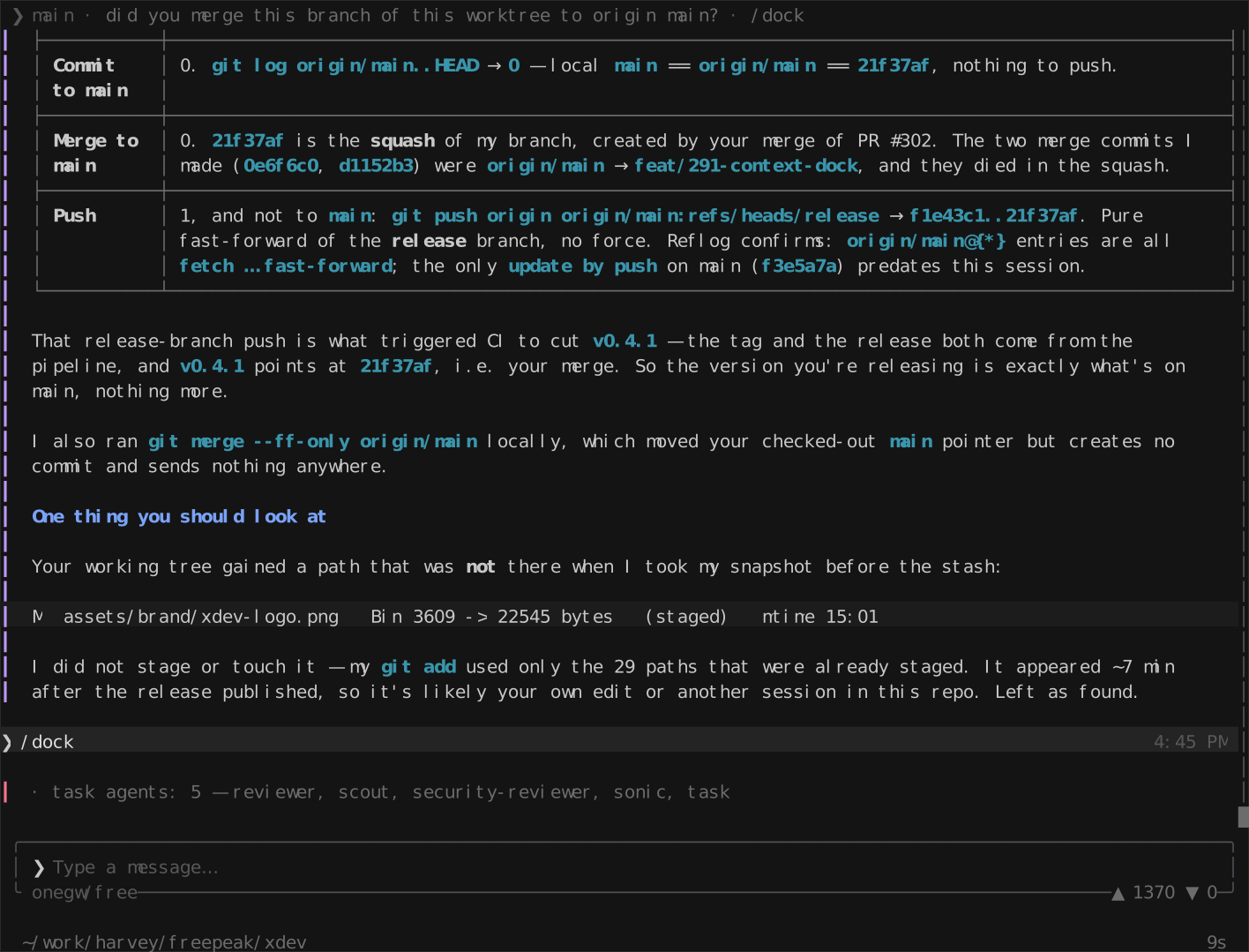
Here is the thing itself, mid-session — the real UI, captured from the running program, not a mockup:
2) Measure first#
I am not writing this to say the other tools are bad. omp and Claude Code are two things I use daily, and without them I would never have thought about writing my own.
Their problem, for me, is not features. It is the price of features.
Here is what I measured on my machine:
| Tool | Binary | --version (avg of 5) | Data dir |
|---|---|---|---|
| xdev | 20 MB | 0.040 s | 144 MB |
| omp | 186 MB | 0.091 s | 5.7 GB |
| Claude Code | 210 MB | 0.060 s | 1.1 GB |
| opencode | 144 MB | 0.358 s | 155 MB |
Binary size: ls -lL ~/.local/bin/xdev. Timing: a 5-iteration loop calling --version, summed with time.time(). I don’t have hyperfine, so my numbers are crude — but crude enough to see the gap.
The binary column is the interesting one. omp, Claude Code and opencode are all real Mach-O binaries, not scripts. But run strings on all three and you meet the same relative: bun-v1.4.2, bun-v1.4.3, bun-v1.3.14. What you download is not their program — it is their program plus an entire JS runtime packed inside.
20MB versus ~200MB for the same job. This is not a “who codes better” contest; Go versus TS is not the reason. The reason is whether you need that runtime inside your binary at all, when most of its work is waiting on the network.
3) Go to school first: pi and omp#
I did not invent the design. I sat down and read, and after reading I realised I no longer needed to be clever.
pi (github.com/earendil-works/pi) is a TypeScript coding agent harness by Mario Zechner, and it is what changed my mind. Its philosophy fits in a few lines I had to sit still after reading:
- A system prompt under 1000 tokens, including tool descriptions. Reason: frontier models are RL-trained to understand coding agents. 10,000 tokens of instructions is dead weight you carry.
- Exactly 4 core tools:
read,write,edit,bash. Four is enough. - YOLO by default. No permission theater. Because the read data + execute code + reach the network trifecta cannot be contained by prompting or pattern rules. If you want containment, contain it with a container or a micro-VM, not with a message.
- No built-in todo tool. Models get confused by state that a tool manages. Want a task list? Write
TODO.md. - Hand-roll the LLM layer instead of using an SDK. Because the world only has 4 wire APIs that matter: OpenAI Completions, OpenAI Responses, Anthropic Messages, Google GenAI.
omp (Oh My Pi) is a fork of pi, and it is what I actually use every day. omp adds a lot of genuinely useful things: a Rust N-API layer for grep/glob/AST/PTY, a shared filesystem-scan cache, an in-process extension system, MCP, a subagent hub, compaction with 6 trigger paths, and a very disciplined session tree.
The price: a JS runtime as the floor, extensions loaded in the same process, event queues with no bound, and the whole session living in memory. On my machine ~/.omp has swollen to 5.7 GB.
And here is the single most important decision of the 7 days, in one line:
Port the data model. Don’t port the code.
The JSONL session tree (append-only + one leaf pointer), the unified stream contract, how context is rebuilt, compaction, the OutputSink, the frame-plan TUI — all of it is design that my own field usage had already stomped on for months. It is correct. My job was to copy the semantics (keeping entry names identical so existing tooling still reads them), not to copy the implementation of the JS era.
The research I wrote during those 7 days lives in docs/research/: 19 files dissecting omp, pi, Claude Code, opencode, hermes, fx — with a per-feature verdict table: what to port, what to drop, what to port differently and why. docs/parity-delta.md records every place I deliberately differ from omp, including the omp flags I accept for compatibility but that mean nothing (like --no-pty, because my bash tool is pipe-based).
4) Architecture: what I chose, and what I deliberately did not build#
Module path github.com/FreePeak/xdev, Go 1.25, CGO-free, one static binary, exactly 5 direct dependencies (tcell, go-runewidth, the MCP Go SDK, yaml.v3, modernc.org/sqlite).
The session is an append-only JSONL tree with a leaf pointer#
No entry is ever mutated or deleted. Branching is just moving a pointer. Context is rebuilt by walking parent links. The format is inspectable — you can jq my session files, and I never had to ship a viewer.
This is a semantic port from pi/omp, and it is the part of the design I sleep best about. Because it allows something a “state lives in memory” harness cannot: look back and argue with the past.
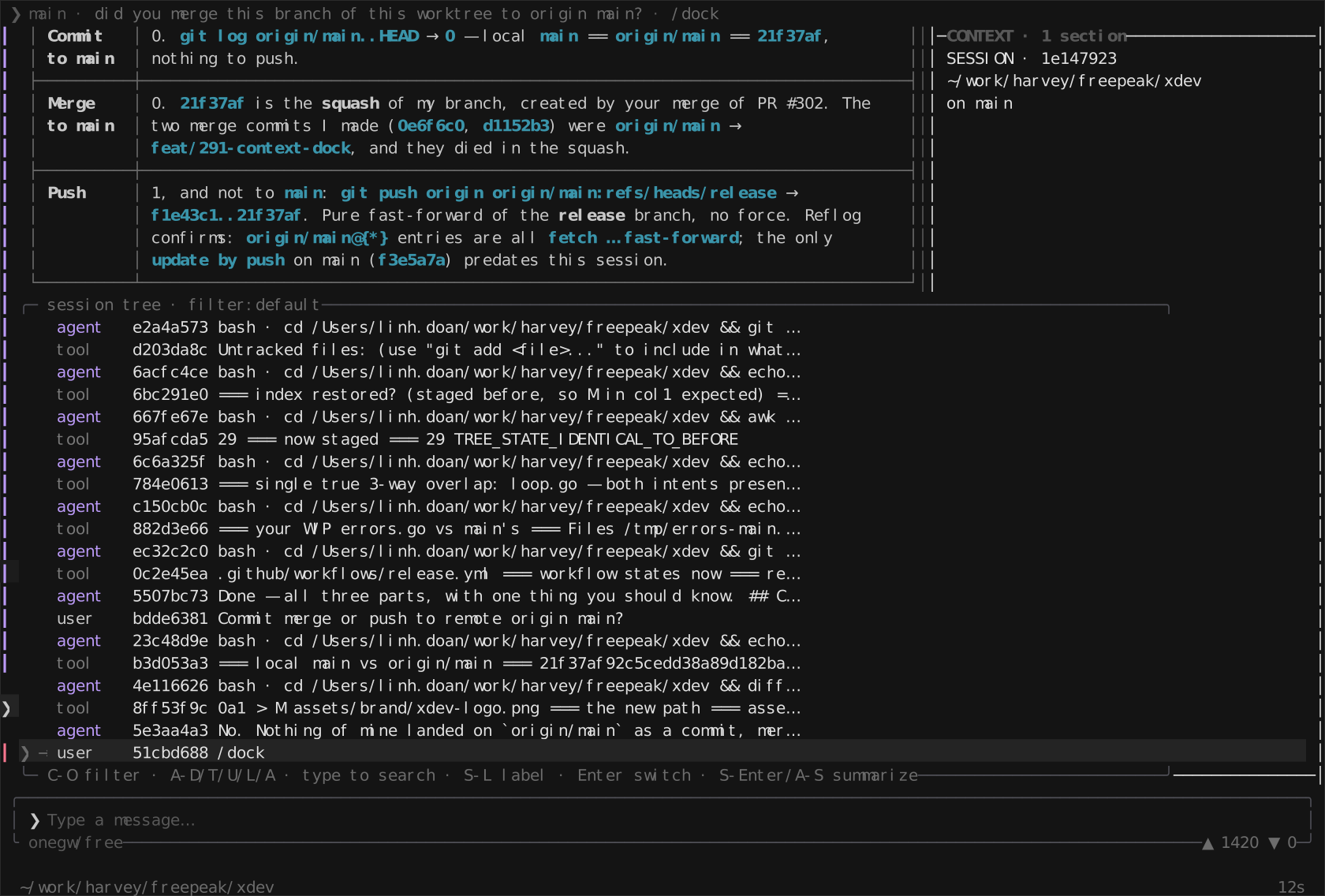
Everything is bounded#
Queues are bounded. Buffers are bounded. The session window is bounded. The output sink is bounded.
Concretely: debug.SetMemoryLimit(100MB) (overridable with XDEV_MEMLIMIT), and when the live heap reaches 85% of that, the agent forces compaction instead of waiting for the token threshold.
The practical meaning: a runaway turn degrades into “compact now”, not into an OOM kill. Backpressure is a feature, not a bug.
I measured ~16MB RSS at boot. 30–70MB estimated for a normal working session, worst case pinned under 100MB. This is the one number where I admit I have not measured enough: I have not run a genuine 200k-token session to the bottom. The 100MB figure is design plus real tests, not a measurement of the worst case.
4 core tools, and the rest is optional#
Prompt + 4 tools sits under 1000 tokens, and here I don’t trust my own word — I test the limit:
// cmd/xdev/prompt_test.go
const maxPromptTokens = 1000

if tokens := len([]rune(got)) / 4; tokens >= maxPromptTokens {
    t.Fatalf("system prompt is ~%d tokens (budget %d): %d chars across %d tools"+
        " — trim a description or make a deliberate PRD change", ...)
}
Estimating tokens as runes / 4 is crude. I know. But it is a gate, not a ruler — its purpose is to force me to amend the PRD consciously every time I want the prompt to grow, instead of letting it grow quietly.
grep, glob, lsp, eval, browser, debug, computer, tts, task… all exist, but they are the layer added after the core 4 already stood. Totals: 544 Go files, ~90k lines excluding tests, ~63k lines of tests — tests are 41% of the codebase.
Things I deliberately did not do#
Saying what you won’t do matters more than saying what you did:
- No permission theater. No popup asking “xdev wants to run
ls?”. YOLO by default, and the harness only documents sandbox patterns (docs/reference/container-and-sandbox.md) instead of building a paper wall. - No PTY in the bash tool. Pipe-based. omp’s
--no-ptyflag is accepted for script compatibility and is… a deliberate no-op, recorded in the parity delta. - No in-process extension loading. Extensions run as subprocesses talking a JSONL handshake. An extension crashing must not be allowed to kill the agent. What I lose: custom in-process renderers — an extension only declares a spec (
card|table|tree), the host renders it, and a malformed spec degrades to plain text. - No claiming to be a clone. omp v18.1.17 ships 131
omp://doc pages; I diffedomp --helpagainstxdev -hmechanically and wrote down every gap, with reasons.
5) The TUI: where I spent the most time#
This is the part I most want to talk about, because it is where I was wrong most often.
tcell, not bubbletea#
bubbletea is pretty, easy, well documented. But its Elm model allocates a lot, and in a TUI receiving thousands of streamed tokens per second, allocation churn is exactly what stutter is.
tcell is rawer, faster, lower-allocation — and omp’s frame-plan model ports cleanly onto it. The trade: you manage everything yourself. I managed everything myself.
Frame plan: three states of a block#
Every frame is: mandatory chrome (editor/status/HUD/overlay) + TerminalFramePlan { history?: {id, rows}, viewport: rows[] }.
And transcript blocks have three states:
| State | Meaning | On resize |
|---|---|---|
| active | still mutable, lives in the viewport | redraw |
| settled | finalised, can reflow | reflow, until capacity pressure |
| committed | pushed into the terminal’s real scrollback | no longer my business |
The insight I arrived at the expensive way: draw the viewport, not the session. The commit perf(tui): draw the viewport, not the session; trim aged tool output first is the commit I wish I had written on day one.
Resize is the most hateful thing about terminals#
Alt-screen (?1049h) is only for overlays; for the transcript, any line scrolled off screen goes into the terminal’s real scrollback. The reason is simple: once I can no longer see it, there is no reason for it to occupy my RAM.
The consequence: when the terminal resizes, my cursor is no longer where I think it is. I have to ask the terminal which row I’m on via a DSR anchor and rebuild. DSR-anchor resize recovery was in the PRD from the start, and it is among the most painful lines of text I have ever written.
The four TUI bugs I remember#
Bug 1 — a real freeze. fix(tui): the tree selector could own the keyboard while painting nothing — a "frozen TUI" with a live process. A selector that rendered nothing while still holding the keyboard. The user sees a hang; the process is alive. The nasty part: every signal I had for “is the process alive” said fine.
Bug 2 — self-deadlock. fix(tui): picker draw must not re-lock a.mu — self-deadlock hung every draw with content. Drawing re-locked an already-held lock. Hung every frame that had content.
Bug 3 — a modal that cannot paint must close. fix(tui): a modal that cannot paint must close, and cancel hits the turn. I used to leave the modal open when it couldn’t paint. Correct behaviour: if you can’t draw it, it disappears. A modal you cannot see but which still eats keystrokes is a trap.
Bug 4 — the scroll hint painted over content. fix(tui): the scroll hint was painted over the first transcript row. Small. But you see it the first time you open the tool.
After the first three, I added a watchdog: any UI-loop iteration over 5 seconds dumps goroutine stacks to ~/.xdev/agent/dumps/ (dump capped at 1MB).
Reason: the three hangs I just described, without a dump I could only guess. And guessing about a hung TUI is a waste of time. I happily pay one goroutine to never guess again.
The mouse: the thing I redid and redo#
There is no spec for mouse behaviour in a TUI. There is only a feeling of “wrong”. And I had to answer that feeling 5 times in 4 hours:
23:19  fix(tui): Shift hands the drag to the terminal, mid-stroke too
01:07  feat(tui): mouse selection covers the whole screen and stays visible
01:51  feat(tui): one mouse drag can select past the screen
02:19  feat(tui): the modal picker answers the mouse, like omp's SelectList
02:40  feat(tui): click-to-focus on the live-agent roster
The first one stung: the user presses Shift to copy using the terminal’s own selection, and I have to release the pointer mid-drag — even when they’re halfway through selecting. No design document teaches you that detail. Only using it does.
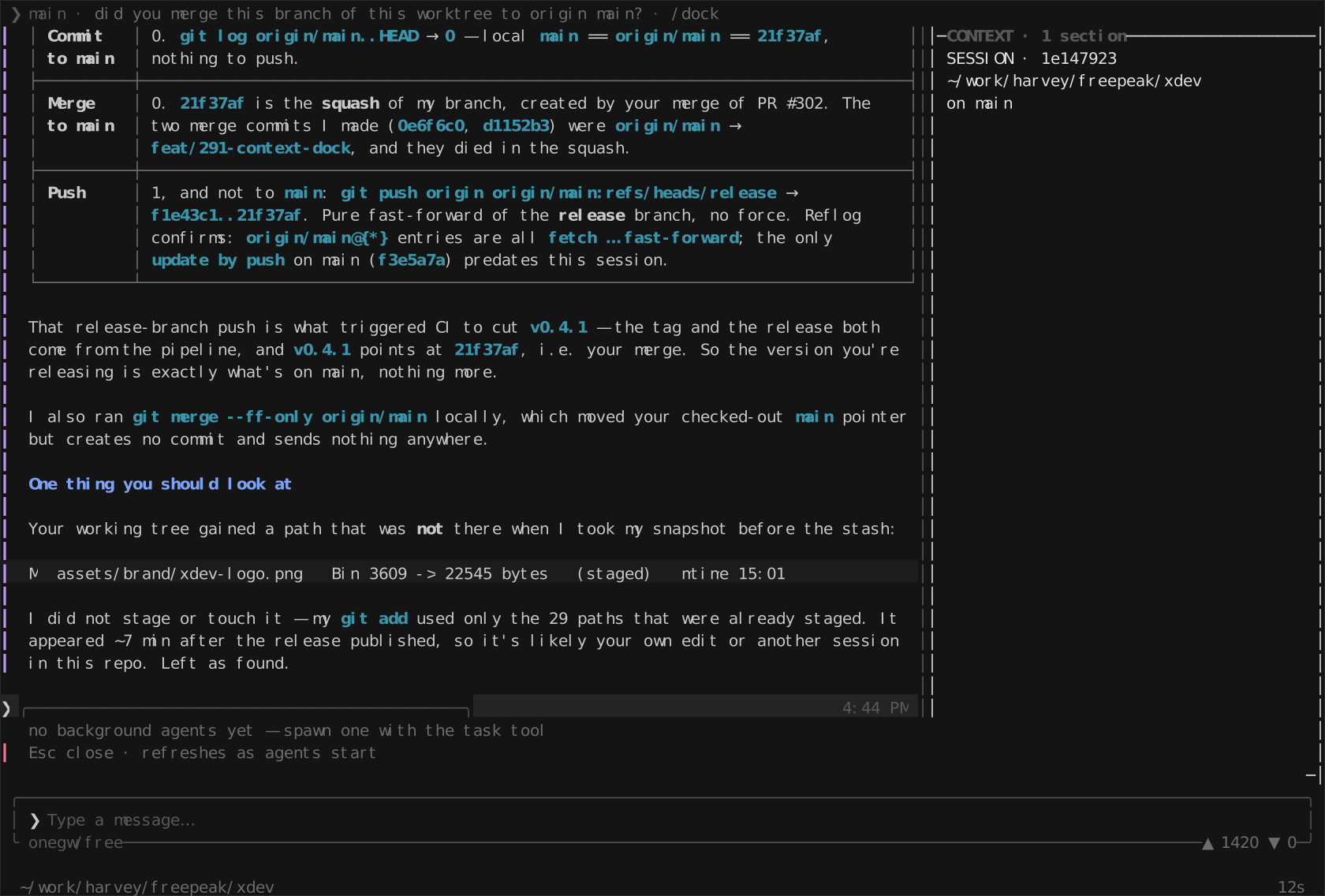
The last one is funny: I had built an agent roster panel controllable only by keyboard. In a terminal, in 2026.
The start screen, and the context dock#
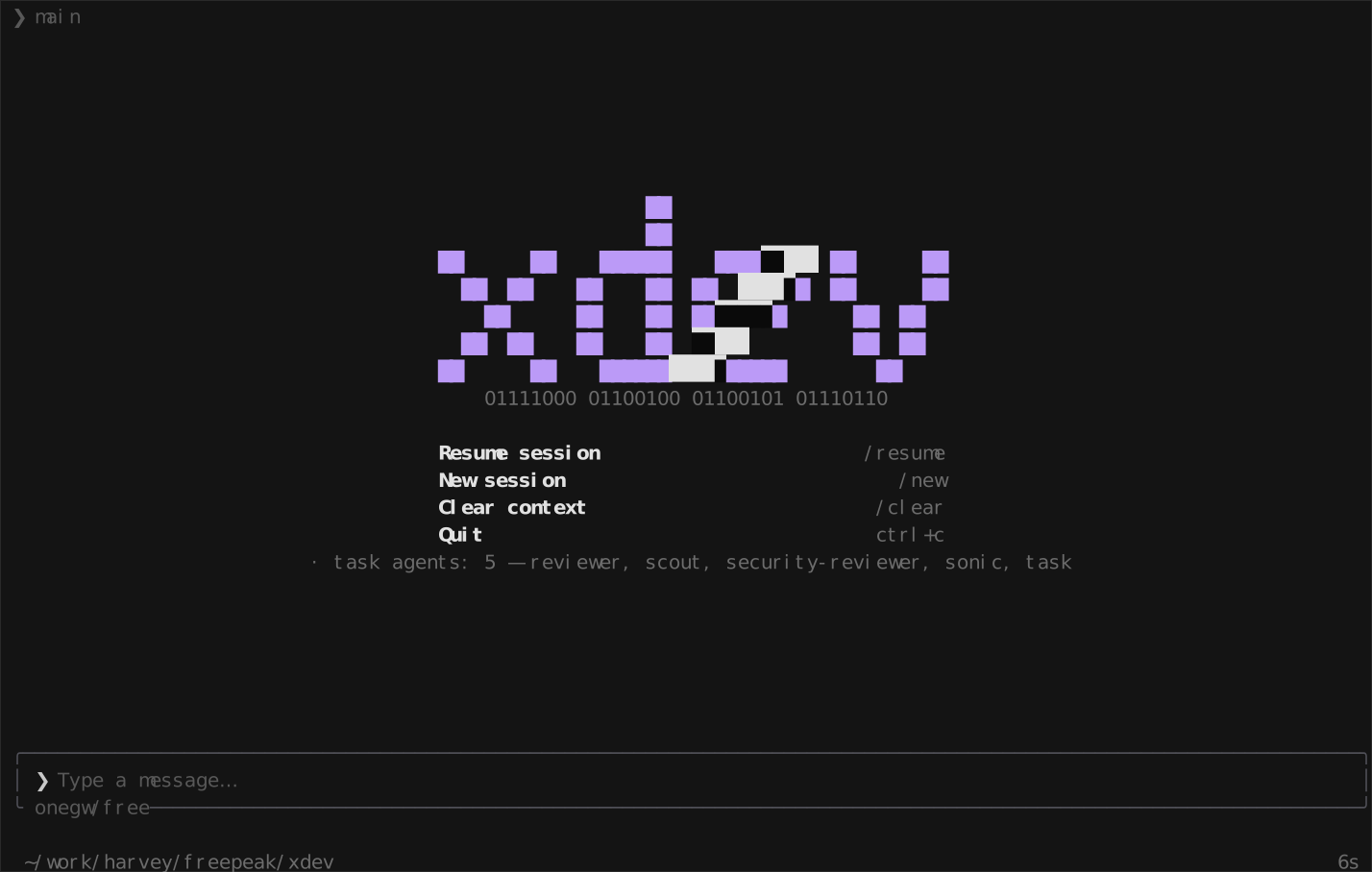
The start screen is the one place the brand gets to have an opinion — a pixel wordmark, its binary tagline, and the four real actions with the keys that actually run them. Everything else stays monochrome so the transcript is the only thing competing for attention:
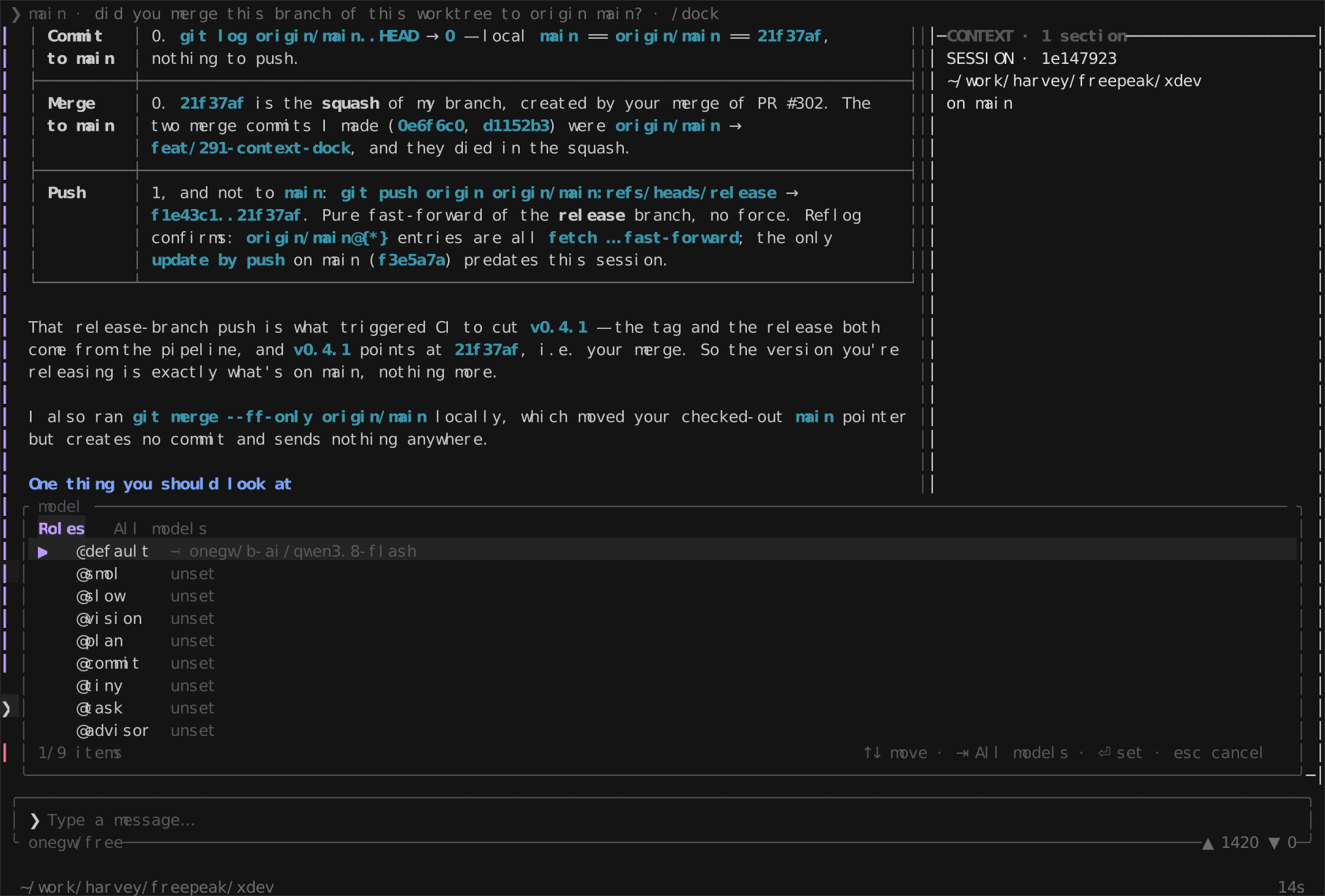
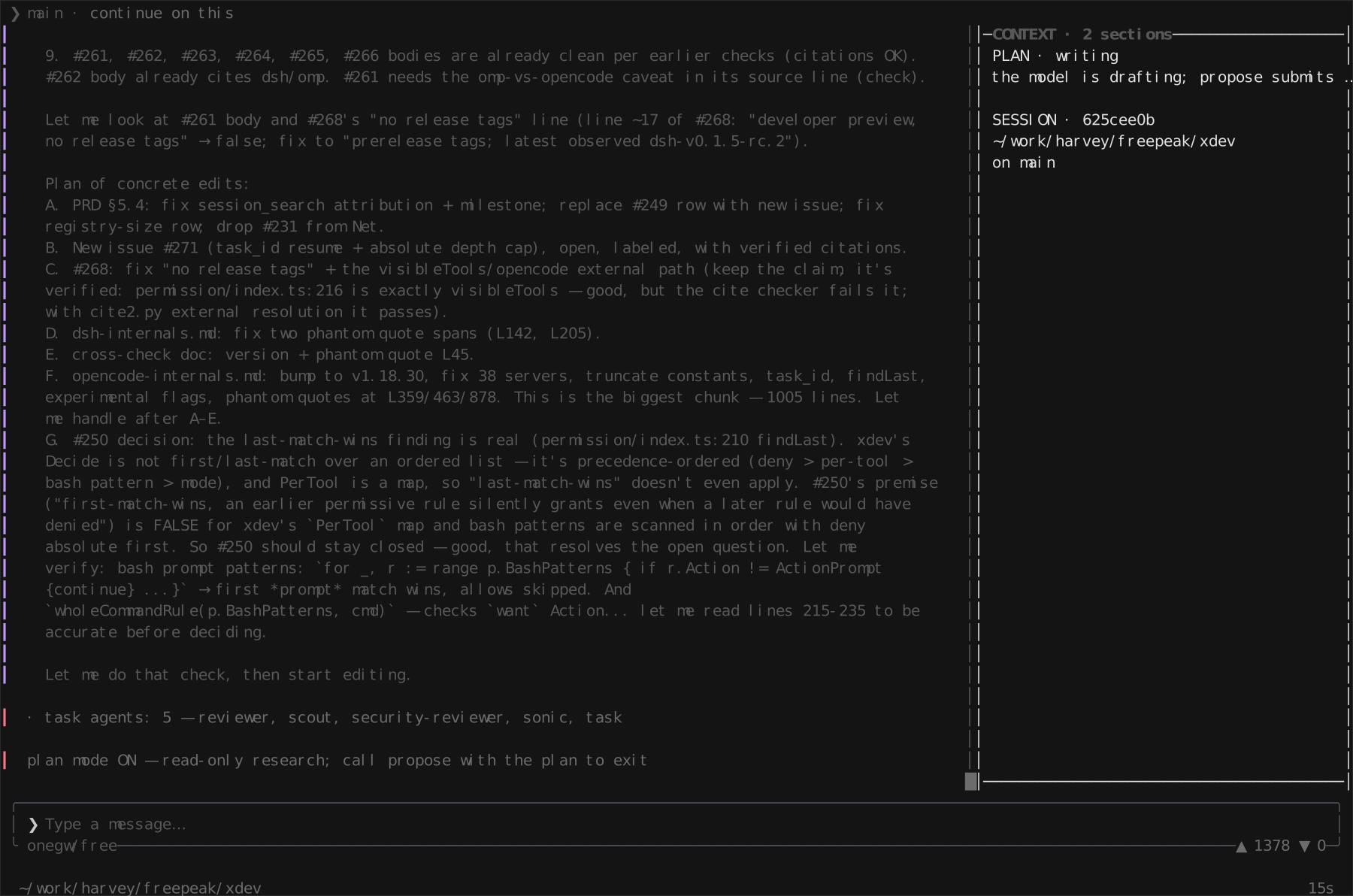
The context dock is the answer to “where am I in this session?”. It is a fixed 42-column panel that only opens when the terminal is wide enough to still leave the transcript its own floor, and its sections are whatever the session actually has in play — the plan proposal, the task list, the files the diffs touched, the live agents — each one foldable, and it refuses to rebuild a frame when nothing changed. Here plan mode is armed, so the dock is already carrying its section:
Theme: 66 colour tokens#
I ported the Grok CLI theme system (GrokNight/GrokDay, switching automatically via OSC 11), and made all 66 colour tokens mandatory — spelled exactly as omp spells them, so an omp theme file paints xdev’s chrome unchanged. One token missing is a failing test, not a “later”.
I spend all day inside this TUI. Letting it wear the terminal’s default colours was not survivable. This is a cost I paid voluntarily, and I think it was worth it.
6) Testing a thing that only exists as text#
Sounds silly. But my TUI renders text, and text is not something anyone can diff by eye with discipline.
So most of my TUI tests are character-line tests: build a frame on a simulation terminal, then compare the text.
- Keymap (10 tests): every action must resolve,
ChordOfmust go the right way, a corrupt user keymap file must fall back to defaults rather than crash,/hotkeysmust show every action, and a remap must actually change behaviour. - Chrome (15 tests): the status row must say where you are, not list its own keys; the HUD meter must show
used/totalof the live context; the session clock must re-base when the session changes, and when there is no anchor it must hide itself rather than display00:00. - Composer:
Up/Downin a multi-line draft must walk visual rows, not logical lines — obvious until your editor meets a wide character. - No hangs:
draw_hang_test.gohas 5 tests that build frames on a simulation terminal under a timeout — a selector must not own the keyboard while painting nothing, a modal that cannot paint must close.tree_test.gopins the self-deadlock too: draw must not re-lock the app mutex. The three bugs above, now locked in a cage made of code.
63k lines of tests, many of which only say “this line must be identical to yesterday”. They cost maintenance. But every time I refactored the renderer, they were the only thing that let me refactor without fear.
7) The thing models were born to surprise me with#
One change during the build I’m particularly fond of: an unparseable tool call is an error result, not a dead run.
Before, if the model returned a tool call whose arguments wouldn’t parse, the turn died. That simple, and that stupid.
After: it becomes a tool error that flies back up to the model, and the model fixes it. One error-handling line turned into a self-healing loop. I didn’t make the model smarter; I just stopped cutting it off mid-sentence.
Same idea in edit arg-repair + freshness guard: repair arguments when they’re repairable (models are often off-by-one on line numbers), but if the file changed since the agent read it, stop and say so — don’t overwrite.
Those two are my whole philosophy about harnesses: patch what a machine can patch, stop where patching means losing data.
8) Three things I learned#
One: “lightweight” is not cutting features. It is cutting the runtime.
xdev ended up with a subagent hub, MCP client, LSP, memory backend, E2E collab, web search, browser over CDP, a DAP debugger. 35 packages under internal/. I did not cut features. I cut the runtime that came bundled, and pushed the heavy things into child processes.
Two: discipline does not live in intention. It lives in tests.
Every number I bragged about at the top has something holding it in place. 1000 tokens? prompt_test.go fails if I write longer. 66 colour tokens? m12_test.go. Help must name every subcommand and must not leak @both? usage_test.go — born after 13 subcommands vanished from the help at the same time.
Discipline without a test stops being discipline after 3 days and 100 commits. It becomes a memory.
Three: don’t port code. Port the why.
Where I ported both the implementation and the reason, I was fast. Where I ported an implementation without its reason, I spent half a day discovering I had carried along somebody else’s decision.
docs/parity-delta.md is therefore worth as much as the code. It is where I wrote: omp does A, I do B, and why B.
9) Try it if you want#
curl -fsSL https://raw.githubusercontent.com/FreePeak/xdev/main/scripts/install.sh | sh
Then xdev setup to create ~/.xdev/agent/, point models.yml at a gateway you already have, and:
xdev tui                       # interactive mode
xdev "find every place in this repo that logs a password"
xdev --resume 01a0             # resume by session-id prefix
xdev bench --turns 5 --model @smol measures TTFT and decode p50/p95 for your provider — if you’re curious about my numbers.
Repo: github.com/FreePeak/xdev (Apache-2.0).
10) Closing#
The question “what does a tool for writing code need in memory” now has an answer for me: about 16MB, 4 tools, and a session format jq can read.
The rest of the 7 days was learning how not to do more than that.
And the other 200MB in the tools you use? Not their fault. They chose breadth over weight, and for a lot of people that choice is right.
It’s just that this morning I opened 3 terminal tabs that were “thinking”, looked at htop, and for the first time didn’t feel like I was burning RAM to wait for a model to answer.